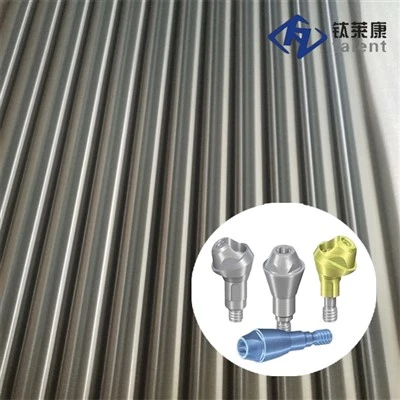
If you’ve ever sourced industrial titanium bars for manufacturing, aerospace, or heavy engineering projects, you’ve probably wondered the same question I hear weekly from spec engineers, plant managers, and maintenance leads: How long do these bars actually last? As a supplier who’s spent the last 12 years working directly with industrial titanium (Ti) stock, I can tell you there’s no one-size-fits-all answer— but there are concrete, data-backed factors that let you predict lifespan accurately, no guesswork required. Industrial Titanium Bars
I started out in this industry back in 2011, fresh out of a materials science apprenticeship, and my first mistake was assuming all titanium bars were created equal. I’d worked in a lab for a semester, testing corrosion resistance, and figured “titanium is titanium, right?” Wrong. Early on, I sold a batch of Grade 2 titanium bars to a chemical processing plant for their pump impeller shafts, and within 18 months, they reached out saying the shafts had pitted and failed prematurely. Turns out, their process ran concentrated hot hydrochloric acid— a environment where Grade 2, while excellent for many applications, isn’t meant to hold up long-term. That mistake taught me a lesson I carry every day now: titanium bar lifespan isn’t based on the metal alone; it’s a mix of grade, processing, and the conditions it’s exposed to.
Let’s break this down systematically, starting with the core variable: titanium grade. Not all industrial titanium is the same, and each grade has a distinct design lifespan for common industrial uses. Our most popular grade, Grade 2 (commercially pure, 99.2% Ti), is the workhorse for everything from marine components to food processing equipment. For applications where it’s not exposed to highly corrosive acids or extreme temperatures above 600°F (315°C), Grade 2 bars regularly last 15–20 years, and often longer when maintained properly. I’ve got a customer who installed Grade 2 titanium valve stems in a desalination plant in Florida back in 2008; they still don’t show signs of significant corrosion, which is unheard of for stainless steel in that exact same environment.
But when you step up to alloyed grades, the lifespan changes drastically. Grade 5 (Ti-6Al-4V), the most common titanium alloy, is used for aerospace fasteners, automotive parts, and pressure vessels. Its strength-to-weight ratio is unbeatable, and for low-stress, non-corrosive environments, it can last 20–25 years. However, if it’s exposed to saltwater or certain acids, its aluminum and vanadium content can leave it more vulnerable to crevice corrosion than pure grades. That’s why we recommend Grade 7 (Ti-0.15Pd) for chemical processing— palladium acts as a corrosion inhibitor, extending its lifespan in harsh acid environments to 12–15 years even when submerged in hot, concentrated acids that would eat through Grade 2 in under five years.
Next big factor: processing quality. A titanium bar’s lifespan starts the second it’s forged, rolled, or extruded. When I first opened my business, I sourced bars from a small mill that cut costs by skimping on the final anneal step. Annealing is critical for titanium—it relieves internal stresses from manufacturing, prevents micro-cracks, and improves uniformity. A customer who used those under-annealed bars for a set of high-stress structural brackets on a cargo ship found that within three years, the bars had developed hidden fatigue cracks from the constant vibration of ocean travel. We don’t source from that mill anymore; now we only work with mills that follow ASTM A494 standards, which dictate annealing and inspection processes that ensure every bar is free of internal flaws. Processed correctly, a titanium bar can outlast its application design life by decades; processed cheaply, it might fail before it even leaves our loading dock.
Then there’s the “environmental equation”— the single biggest variable in lifespan. I’ve seen Grade 2 bars hold up for 30+ years in a clean marine environment, only to corrode through in 12 months when dipped in a warehouse holding acidic fertilizer runoff. Let’s get specific about the main environmental stressors:
Corrosive media: Acids, salts, and even certain brines are the biggest threats. Titanium forms a protective oxide layer (TiO2) that self-heals when scratched, but it can be breached by specific chemicals. For example, it resists sulfuric acid well at low concentrations, but above 10% concentration and temperatures over 120°F (49°C), that oxide layer breaks down rapidly. Chlorides, common in marine and food processing, rarely affect titanium at standard atmospheric pressure, but at high temperatures and pressures (like in deep-sea oil equipment), they can cause crevice corrosion over 8–10 years, which is why we often recommend Grade 9 for offshore oil and gas components.
Temperature extremes: Titanium retains its strength at both high and low temperatures, but there are limits. Below -450°F (-268°C), it becomes brittle, which can lead to sudden failure in cryogenic applications like liquid natural gas (LNG) piping. Above 1000°F (538°C), the oxide layer starts to thicken unevenly, leading to scaling and gradual material loss. In aerospace jet engine components, Grade 5 bars might last 10–12 years when exposed to steady high heat, but only if they’re coated with a thermal barrier to slow that oxidation.
Mechanical stress: Fatigue, bending, and repeated loading are another key factor. Titanium has excellent fatigue resistance, but in cyclic applications like rotating shafts or structural supports that move under load, micro-cracks can form over time. We see this with parts for wind turbine blades: Grade 5 titanium bars used for the blade’s pitch mechanism last 18–22 years, as long as the design avoids sharp stress concentrations that would speed up crack growth. If a bar is machined with rough edges or not sized correctly for the load, lifespan can drop to 5–7 years.
I get asked all the time: can you extend the life of an existing titanium bar? The short answer is yes, but it depends on how much damage it’s already sustained. For minor surface scratches from handling, we recommend a light passivation process that removes surface contaminants and helps rebuild the oxide layer. For parts with light pitting, polishing can smooth the surface and prevent further corrosion from spreading. We had a customer with a set of Grade 7 titanium reactor coils that had small, localized pitting after 8 years in a chemical plant; we sent them to a specialty finisher for polishing and passivation, and they’ve now lasted another 7 years with no issues. But if a bar has deep cracks or has suffered from intergranular corrosion (where the oxide layer fails at the grain boundaries), there’s no way to repair it— it’s time for a replacement.
Now, let’s compare that to other common metals to put titanium’s lifespan in perspective. A 316 stainless steel bar in the same mild marine environment as my Florida desalination plant valves lasts 8–10 years before it starts pitting. Carbon steel? It barely makes 2–3 years before it’s rusted through. Aluminum? Even with coatings, it tops out at 5–7 years in that environment. That’s why industrial titanium bars aren’t just a premium cost— they’re a long-term investment that saves on replacement, downtime, and maintenance costs. I work with a food processing company that switched from stainless steel to Grade 2 titanium for their conveying lines in 2012; they’ve only had to replace one small section in that time, versus 12 stainless steel replacement runs before that, which added up to hundreds of thousands in downtime and parts.
Of course, there are edge cases where titanium might not be the right choice, but that’s where our expertise comes in. We don’t just sell bars— we help customers match the right grade to their application so they get the maximum lifespan possible. A few years back, a customer came to us needing bars for a set of heat exchangers in a zinc smelter, where the process ran concentrated sulfuric acid at 180°F. They initially asked for Grade 2, but our team did a site assessment and found the environment was pushing Grade 2’s limits. We recommended Grade 12, which has extra molybdenum for corrosion resistance in hot acids, and those bars are now 7 years in with no signs of degradation. That’s the kind of attention to detail that separates a good supplier from a great one.
So, to circle back to the original question: how long do industrial titanium bars last? For most standard industrial applications, with the right grade, proper processing, and installation, you can expect 15–25 years of service, sometimes more. In harsh, specialized environments, that drops to 5–15 years, but that’s still far longer than most alternative metals. The key is not guessing at the grade, or cutting corners on processing, or ignoring environmental factors— work with a supplier who will guide you through every step.
If you’re working on a project, whether it’s a new construction build, equipment replacement, or a design tweak, and you want to get a concrete, realistic lifespan estimate for industrial titanium bars tailored to your specific conditions, our team is here to help. We don’t do one-size-fits-all quotes, and we don’t sell product that’s not right for your needs. Reach out to start a conversation, and we’ll walk you through everything from grade selection to processing specifications to make sure you get the longest, most cost-effective service life from your titanium bars.
Medical Titanium Wires References:
- ASM International. (2019). Materials Selection and Design, Volume 2: Properties of Titanium Alloys. ASM International.
- ASTM International. (2022). Standard Specification for Titanium and Titanium Alloy Bars and Billets. ASTM A494-22.
- Schweitzer, P. A. (2020). Corrosion Resistance: Titanium Alloys. CRC Press.
- National Association of Corrosion Engineers (NACE). (2018). Titanium in Industrial Corrosion Environments. NACE International.
Baoji Tailaikang High-Tech Metal Materials Co., Ltd.
With abundant experience, we are one of the most professional industrial titanium bars manufacturers and suppliers in China. Please feel free to buy industrial titanium bars for sale here and get pricelist from our factory. For price consultation, contact us.
Address: No.1, Southeast Cross of Gaoxin Avenue and Fenghuang 3rd Road, High-tech Development Zone, Baoji City, Shaanxi Province, China
E-mail: sale@tlkjs.com
WebSite: https://www.tlkmetal.com/
