If you’ve ever worked in electronics manufacturing, precision assembly, or lab testing, chances are you’ve stood on an anti-static rubber mat (ASRM) without even thinking twice about it. As a supplier who’s spent the last 12 years designing, testing, and shipping these mats to facilities across 27 countries, one question I get asked more than any other is: “What’s the maximum load capacity of an anti-static rubber mat?” It’s not a trivial question—overloading a mat can crack its conductive layer, ruin its static-dissipative properties, and lead to thousands of dollars in damaged electronic components. Let’s break this down like we do in our quality lab, no jargon, just real-world answers that matter to anyone sourcing these mats for their workspace. Anti-Static Rubber Mat
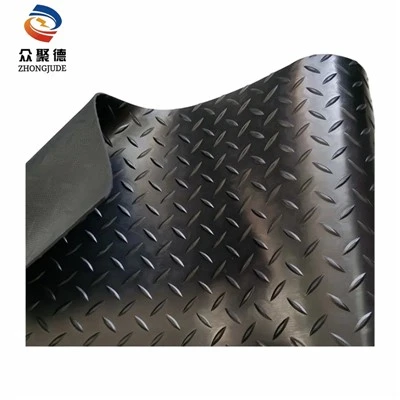
First, let’s start with what anti-static rubber mats are made of, because their load capacity isn’t random. Most standard ASRMs are a three-layer structure: a top protective layer (usually 1.5mm to 2mm thick) that’s resistant to abrasions, chemicals, and scuffs, a middle conductive filler layer (typically carbon black or metal particles like nickel or silver) that moves static charge away from your body to ground, and a bottom layer (1mm to 1.5mm thick) that’s designed to stick to the floor without slipping. The total thickness of a standard mat ranges from 3mm to 5mm for general-use models. Thicker mats—up to 10mm—are for heavy-duty industrial applications, like where we’ve shipped mats to aerospace part assembly lines that handle large, heavy avionics components.
Now, the maximum load capacity. For most standard 3mm to 5mm thick ASRMs, the sweet spot is 500 kilograms (1100 pounds) per square meter. Wait, let’s translate that to something easier to visualize: a 1m x 2m mat (the most common size for workbenches) can safely hold up to 1000kg (2200lbs) evenly distributed across its surface. That’s roughly the weight of a small pickup truck, so for most workstations—where you have a soldering iron, a bin of resistors, a work lamp, and maybe a rolling chair—this is more than enough. But here’s the catch: that number only applies to even, distributed load. If you set a 50kg (110lbs) toolbox on just one corner of a 1m x 1m mat, that spot is taking the full force of the weight, not the average. That’s when you get into trouble—localized pressure can puncture the rubber, break the conductive layer, and render the mat useless for static control.
Heavy-duty mats, which we use for automotive electronics assembly or heavy lab equipment, have a higher load capacity. Our 8mm thick industrial-grade ASRMs can handle up to 1200kg (2645lbs) per square meter. For context, a 2m x 3m heavy-duty mat can hold up to 7200kg (15873lbs) evenly. That’s enough to support a small industrial press or a full rack of test equipment without permanent deformation. But even these have a limit—we tested one 10mm thick mat with a localized 1500kg (3307lbs) weight on a 10cm (4-inch) diameter spot, and it left a permanent indentation. Over time, that indentation would cause the conductive layer to crack, so we don’t recommend exceeding 1000kg per localized point even on heavy-duty models.
Let’s talk about what causes a mat to fail under load, because it’s not just “too much weight.” First, material elasticity: rubber mats, even the high-quality ones we supply, are elastic, not rigid. When you put weight on them, they compress under pressure. For standard mats, the maximum safe compression is around 10% of their total thickness. If you compress a 5mm mat by more than 0.5mm, you risk damaging the conductive particles embedded in the middle layer. Those particles need to stay evenly dispersed to create a continuous path for static charge. If the mat compresses too much, the particles clump together, leaving gaps where static can’t dissipate. That’s a failure mode we see all the time—customers put a heavy vise on their workbench mat, notice that component ESD rates jump 20% after a month, and assume the mat is defective. It’s just overcompression from a localized load.
Another factor is the mat’s foundation. A 2m x 2m mat sitting on a solid concrete floor can handle way more weight than the same mat on a wooden workbench or a raised floor with weak joists. We recently had a customer in Singapore who installed a 10mm heavy-duty mat on a raised data center floor, and within two weeks, the mat had permanent indentations. Turns out the floor joists beneath the mat were only spaced 60cm (2ft) apart, so the mat was sagging between them. The load capacity we quote is for mats installed on a flat, rigid surface like concrete. If your work surface is flexible, cut your effective load capacity in half to avoid sagging and permanent damage.
Let’s also cover common myths that come up when people ask about load capacity. One I hear a lot: “Can I use my anti-static mat as a step mat for a forklift?” No, that’s not what it’s designed for. ASRMs are for foot traffic, workbench use, and small to medium equipment. Forklift tires can exert up to 10,000kg per square meter of pressure on a surface, which is 10 times the maximum load for even our heavy-duty mats. That’s a surefire way to destroy a mat in one use. Another myth: “Thicker mat = higher load capacity 1:1.” Not exactly. A 10mm mat doesn’t have twice the load capacity of a 5mm mat. Our lab tests show that load capacity increases linearly with thickness up to 8mm, but beyond that, the gains are minimal. A 10mm mat only handles 20% more weight than an 8mm one, not double. The extra thickness is for chemical resistance and durability, not just load.
So, how do you calculate the load capacity for your specific workspace? Let’s walk through it step by step. First, measure the area of your mat: if it’s a 1.2m x 1.8m workbench mat, total area is 2.16 square meters. Multiply that by the load capacity per square meter for the mat type. Standard workbench mats: 500kg/m², so 2.16 x 500 = 1080kg (2381lbs) total evenly distributed. If you’re using a heavy-duty industrial mat, it’s 1200kg/m², so 2.16 x 1200 = 2592kg (5714lbs) total. Now, add a safety factor—we always recommend using 70% of that total to account for unevenly placed tools, parts bins, or foot traffic. That means your 1.2m x 1.8m standard mat should only hold ~756kg (1667lbs) total, and the heavy-duty version ~1814kg (3999lbs). That’s the number we tell our customers when they ask for a recommendation, because we don’t want anyone to risk damaging their mat or their components.
Now, if you’re not sure which mat is right for your load, we offer custom testing. In our 12 years in business, we’ve worked with companies from startup electronics labs to NASA’s satellite assembly facilities. We’ve tested mats for 3D printing stations that handle light tools, automotive plants that hold engine components, and clean rooms that require strict ESD compliance. For example, a customer in Germany needed a mat for their new line of electric vehicle battery packs, which weigh up to 800kg each. We worked with them to design a custom 10mm mat with a reinforced base layer that can hold 900kg per square meter, enough to support the battery pack without any risk of damage. That’s the kind of tailored solution we don’t get from big box retailers—we’re a supplier that works with you to match the mat to your specific use case, not just sell you a one-size-fits-all product.
Wait, let’s talk about signs your mat is already overloaded. If you notice permanent indentations in the mat, cracks in the top layer, or if your static meter starts giving inconsistent readings when you work, that’s a sign. Conduct a simple test: place a 1kg weight on the mat’s surface, then check the ESD rating. If the reading is within the standard 10⁶ to 10⁹ ohms per square meter (the industry standard for anti-static mats), the mat is fine. If it’s outside that range, you’ve either damaged the conductive layer from overloading, or the mat is worn out from other factors. At our company, we offer free ESD testing for all customers who buy our mats, so you can confirm your mat is working as it should.
Now, why does this matter beyond just the mat’s lifespan? ESD damage costs the electronics industry over $5 billion a year, according to recent studies. A single overloaded mat can lead to static discharge that ruins a $10,000 microchip, or a batch of components worth $50,000. That’s why getting the load capacity right isn’t just a maintenance tip—it’s a way to protect your bottom line. As a supplier, we don’t want you to have to replace a mat every 6 months because you used it for something it’s not designed for. We want you to use your mat for 5 to 7 years, which is the average lifespan for a high-quality ASRM, and avoid costly ESD failures in your process.

If you’re in the market for an anti-static rubber mat, or you’re not sure if your current mat is suitable for your load, we’re here to help. We don’t just sell mats—we offer consultations to assess your workspace, recommend the right thickness and type, and provide testing services to make sure your mat meets your needs. Whether you’re setting up a new lab, upgrading your production line, or replacing a worn-out mat, we can work with you to find the perfect solution. Reach out to our team for a no-obligation consultation, and we’ll walk you through everything you need to know to get the right mat for your load.
FKM Rubber Sheet References
- Electrostatic Discharge Association (ESDA). “Standard for Electrostatic Discharge Control – General Requirements,” ANSI/ESDA S20.20-2021.
- Rubber Manufacturers Association. “Properties of Synthetic Rubber Mats for Industrial Applications,” 2022.
- International Organization for Standardization (ISO). “Electrostatic characteristics for footwear and matting,” ISO 14726:2019.
- Electronics Industry Alliance (EIA). “Cost of ESD Damage in Global Manufacturing,” 2023 Report.
Hebei Zhongjude Power Technology Co., Ltd.
With abundant experience, we are one of the most reliable anti-static rubber mat manufacturers and suppliers in China. Welcome to buy bulk high quality anti-static rubber mat for sale here and get quotation from our factory. For price consultation, contact us.
Address: Shenghe Plaza, No. 88 Qilian Street, High-tech Zone, Shijiazhuang City, Hebei Province, China
E-mail: zhongjude@outlook.com
WebSite: https://www.zjdinsul.com/
