If you’ve ever wandered through a French village square, a Mediterranean resort, or even a backyard barbecue in North America and Europe, you’ve likely spotted a group of friends tossing glossy metal balls across gravel, laughing as their balls clack against one another. That’s pétanque—a sport that feels equal parts casual gathering and strategic competition, far simpler to learn than it looks, but with enough nuance to keep players coming back for decades. As a supplier of pétanque boules, I’ve spent thousands of hours handing out sets to new players, answering questions over video calls, and watching first-timers turn into regulars. Today, I’m breaking down exactly how to play, from the basics of equipment and setup to the little tricks that turn a casual game into a winning one. Petanque Boules
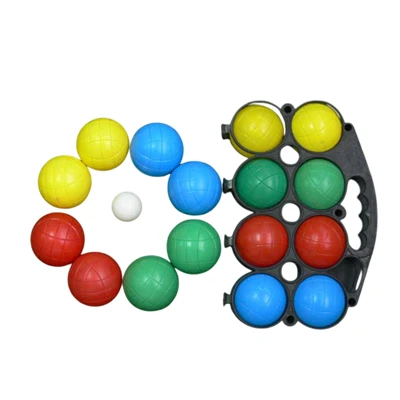
First, let’s start with what you actually need. Pétanque boules aren’t just decorative metal balls—they’re precision tools, designed to roll consistently and knock smaller balls (called the jack or cochonnet) out of the way. A standard set for two to four players has eight boules, split evenly between two teams: four for Team A, four for Team B. The boules themselves come in different weights and sizes, but most recreational sets use boules between 700 and 800 grams, with a diameter of around 70 millimeters. For beginners, we often recommend a set of “inox” (stainless steel) boules—they’re durable, easy to handle, and don’t require the same level of maintenance as chrome or brass sets, which can tarnish over time if left out in damp grass. The other essential piece of equipment is the jack: a small wooden ball, usually around 30 millimeters in diameter, that serves as the target for every shot. Some casual players use small rubber balls or even tennis balls as a stand-in, but a proper jack makes the game far more precise.
Next, the field. Pétanque doesn’t need a fancy stadium—most games are played on a flat, compacted surface of gravel, sand, or even dirt, as long as it’s free of large rocks or holes that could throw a shot off. A regulation pétanque pitch is 4 meters wide and 15 meters long, but for casual play, you can easily play on a 3×10 meter area in your backyard, a park, or even a parking lot (just watch out for curbs!). Before starting a game, the captain of the team that won a pre-game coin flip (or, if no coin flip, the captain of the team that lost the previous game) stands at one end of the pitch and draws a circle with their foot. The circle needs to be at least 50 centimeters in diameter, and it has to be completely on the ground—no standing on a curb or a raised patio edge. All players from the starting team must stand inside this circle to throw their first boule, and their feet can’t touch the circle’s edge or ground outside the circle until the boule is released. That’s a rule new players break all the time, so keep that in mind.
Now, the core of the game: how to take a shot. The first team to throw starts by placing the jack exactly 1 to 3 meters from the circle. Wait, 1 to 3 meters? That’s not a typo—unlike many sports with fixed target distances, pétanque’s jack distance is flexible. For casual games, we usually recommend keeping it between 1.5 and 2 meters for beginners, so shots aren’t too hard to reach. Once the jack is placed, the first player from the starting team picks one boule and stands in the circle. Here’s the key: in pétanque, you never throw the boule like a baseball or a bowling ball. You hold it flat in the palm of your hand, with your thumb on top and your fingers curled underneath, and you rock your arm forward in a smooth, underhand motion—no overhand throws allowed. The goal here is either to roll your boule as close to the jack as possible (called a “point shot”) or to knock the opponent’s boule away from the jack (called a “shoot shot”).
Let’s break down the two main shot types, because they’re the backbone of every game. The point shot is the most common, especially for beginners. To execute a good point shot, you need to aim straight for the space just in front of the jack, letting the boule roll slowly, with a steady, straight line. Don’t throw too hard—pétanque boules don’t have much bounce, so a hard throw will likely roll past the jack and land far away. For new players, practice rolling a boule back and forth across a flat patch of gravel without veering left or right; once you can do that, you can move on to aiming at the jack. The shoot shot, on the other hand, is about power and precision. When you shoot, you want to hit your opponent’s boule (or even the jack, if you’re lucky) dead-center, with enough force to knock it out of the way. But be careful: if you miss, your boule might land right next to the jack, giving the opponent an easy point shot. We always tell new players to master point shots first before trying too many shoot shots—luck favors the prepared, and a consistent point shot will win far more games than a risky, poorly executed shoot.
Once the first team throws their boule, the second team takes their turn. They can either throw a boule to get closer to the jack than the first team, or shoot the first team’s boule away. This back-and-forth continues until all boules from both teams are thrown, usually after 8 total shots (4 per team). Now it’s time to count the points—and this is where pétanque gets interesting. Only one team gets points per round, and it’s based on how close their boules are to the jack. If Team A has a boule 10 centimeters from the jack, and Team B has a boule 20 centimeters away, Team A gets 1 point. But if Team B has two boules closer than Team A’s closest boule, Team B gets 2 points, and so on—up to a maximum of 4 points, if all four of your boules are closer than the opponent’s. For example: if the jack is in the middle, and your boules are 5, 10, 15, and 20 centimeters from it, while the opponent’s are 25, 30, 35, and 40 centimeters away, you get 4 points. That’s a “carte blanche,” a rare and satisfying win in one round.
Wait, what if the jack gets knocked out of bounds? If it rolls outside the pitch or stops against a large obstacle (like a curb or a tree), the round is void—no points, and the same team that threw the jack starts a new round. If the jack is still in bounds, but one of the boules is knocked out, it doesn’t count for that round, so you ignore it when counting distances. That’s another rule that trips up new players, so always double-check where the jack and all boules landed before counting.
Now, what about strategy? Pétanque might seem like a casual, laid-back game, but experienced players use a lot of strategy. For example, if your team is winning, you might focus on point shots to build a lead, making sure your boules are always close to the jack so the opponent can’t catch up. If you’re trailing, shoot shots are your best bet—knock the opponent’s boules away to create space for your own. Another common tactic is the “mouton,” a boule that’s placed just a little too far from the jack to be a point, but close enough to block the opponent’s shot. If you place a mouton between the jack and the opponent’s hand, they have to either shoot it away (risking a miss) or throw their own boule around it (which is harder to do). It’s a simple trick, but it’s used in almost every competitive game.
I’ve seen players of all ages get hooked on pétanque—teens playing at parks, retirees gathering every weekend in their neighborhood, even corporate groups using it for team building events. What makes it so appealing is that it’s inclusive: you don’t need to be a great athlete to play. A 70-year-old can have just as much fun as a 20-year-old, because the skill is in precision, not speed or strength. That’s why so many people come back to it, and why our boules sets are such a popular item—we get emails from parents buying sets for family barbecues, companies ordering bulk sets for team events, and even schools looking for outdoor activities for students.
Now, a few tips for first-time players that I’ve learned over the years. First, don’t rush your shot. It’s easy to get caught up in the energy of a game and throw a boule before you’re ready, but that’s the fastest way to miss. Stand in the circle, take a deep breath, line up your shot, and throw when you feel comfortable. Second, watch the other players. When someone is throwing, pay attention to how they hold their boule, how they stand, and how they aim. A lot of beginners copy the pros, and it works. Third, take care of your boules. Even the most durable boules will get scratched or dented if you leave them out in the rain, or drop them on hard pavement. We recommend storing your set in a soft bag, away from extreme temperatures, and wiping them down with a dry cloth after each use. It’s a small step, but it will make your boules last for years.
If you’ve tried pétanque before and struggled with distance, or you’re looking to upgrade your first set, we have boules for every skill level. Our recreational sets are perfect for casual backyard games, with smooth, easy-to-roll boules that don’t require a lot of experience to use. For more advanced players, we offer precision-machined boules with custom weights and sizes, designed for competitive play. We also carry all the accessories you need: jacks, scoreboards, soft carrying bags, and even portable gravel mats for playing on uneven surfaces.
Whether you’re planning a family gathering, a team building event, or just looking for a fun new hobby, pétanque is a game that brings people together. It’s low-cost, easy to learn, and has a way of turning strangers into friends. If you’re ready to start your own pétanque games, or if you’re interested in ordering bulk sets for an event, don’t hesitate to reach out. We’d be happy to answer any questions about our products, help you choose the right set for your needs, and even share tips on how to organize a game. Let’s get rolling—your next favorite game is just a boule toss away.
Wooden Bocce Ball References
- International Federation of Petanque and Provencal Game (FIPJP) Official Rules.
- "Pétanque: The Complete Guide" by Jean-Pierre Rives, 2019.
- Recreational Sports Participation Trends, Outdoor Industry Association, 2022.
Hebei Honde Industrial Trade Imp. & Exp. Co., Ltd.
As one of the most experienced petanque boules manufacturers and suppliers in China, we have world-leading production equipment and strong manufacturing capabilities. Please feel free to wholesale customized petanque boules made in China here from our factory.
Address: Room 1904, Yintai International Building, Guang’an Street, Chang’an District, Shijiazhuang, Hebei Province
E-mail: activeballs@hbhonde.com
WebSite: https://www.hbactiveballs.com/
