Hey there, it’s Mia from the carrier tape materials team—today I’m pulling back the curtain on a question I get all the time from our partners in electronics manufacturing: how well do carrier tape materials hold up against UV resistance? If you’ve ever worked with SMT components, you know carrier tape isn’t just plastic that holds resistors, capacitors, or semiconductors in place for pick-and-place machines. It’s a critical part of ensuring parts get where they need to go, exactly when they need to work—especially for products that end up in outdoor gear, automotive sensors, or even satellites, where UV exposure isn’t just possible, it’s inevitable. Carrier Tape Materials
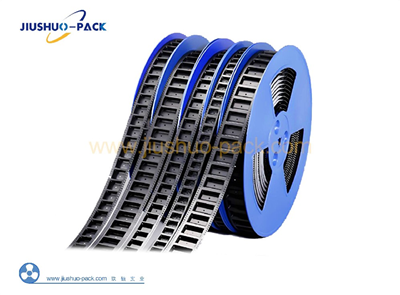
Let’s start with why UV resistance matters, because I don’t want to skip the basics that trip up even seasoned engineers. Ultraviolet radiation from the sun (and sometimes from LED or fluorescent lighting in warehouse assembly lines, for that matter) breaks down molecular bonds in most polymers over time. That’s photodegradation, plain and simple. For carrier tape, that breakdown doesn’t just make the tape look cloudy or brittle—worse, it can warp the pockets holding tiny surface-mount components, or leach additives that contaminate the parts. I’ve seen a batch of tape that sat in a loading dock for two weeks turn so brittle it cracked mid-assembly, costing a client a full production run of automotive ECU sensors. That’s the kind of real-world headache we design to avoid.
Now, let’s talk about the materials we work with every day, and how each stacks up for UV resistance. As a supplier, I don’t just push one material—because every application has different needs, and UV resistance is non-negotiable for some. Let’s break down the big four:
First, polystyrene (PS). This is the workhorse carrier tape for low-cost, indoor electronics. PS is lightweight, formable, and cheap, but its UV resistance is almost nonexistent—unless you add additives. Unmodified PS starts to yellow and get brittle after just a few hundred hours of direct sun exposure. I’d never recommend standard PS for any project where parts will see outdoor light, or even for tape stored near warehouse skylights. That said, if you’re using PS for a strictly indoor, short-run project, it’s fine—just don’t leave it sitting out.
Next, polycarbonate (PC). PC is way tougher than PS—you know it from bulletproof glass or smartphone cases. Its base UV resistance is better, but still not perfect for long-term outdoor use. Unmodified PC will start to haze and lose impact strength after about 1,000 hours of UV exposure. For medium-term projects, like consumer electronics that go on camping gear (think wireless trail camera sensors), we’ll add UV stabilizers to PC to boost its performance. Last year, a client making solar-powered trail cams switched from standard PC to our UV-stabilized PC carrier tape, and they reported zero pocket warping after six months of field testing in Arizona’s intense sun. That’s the kind of win we live for.
Then there’s polyethylene terephthalate (PET, often called PETG when it’s glycol-modified). PET is super popular for carrier tape because it’s durable, has good dimensional stability, and—this is key—its base UV resistance is much higher than PS or standard PC. Unmodified PET can hold up to about 2,500 hours of UV exposure before showing significant degradation. For products that need to last a few years outdoors, like outdoor security camera parts, we’ll use UV-stabilized PET (we add hindered amine light stabilizers, or HALS, to the mix, which I’ll explain in a second). PET is also more resistant to moisture than PC, so it’s a double win for parts that deal with both sun and humidity.
Last, for the heavy-duty stuff: polyether ether ketone (PEEK). Wait, I know PEEK sounds overkill for carrier tape, but hear me out. PEEK is a high-performance engineering polymer that’s heat-resistant, chemical-resistant, and—most importantly for our topic—extremely UV-resistant. Unmodified PEEK can last more than 10,000 hours of direct UV exposure without significant degradation. That’s why we use PEEK carrier tape for aerospace components, satellite sensors, and even parts for offshore wind turbines, where tape might sit exposed on a loading dock for months before installation. It’s not cheap, but for applications where failure isn’t an option, it’s the only way to go.
Now, let’s talk about the additives that make all the difference, because this is where a lot of suppliers cut corners, and that’s where we stand out. I mentioned HALS earlier—these are the most common UV stabilizers for carrier tape, and they work by scavenging free radicals that form when UV light breaks polymer bonds. But not all HALS are equal. Some cheap HALS break down themselves after a few hundred hours of UV, so the tape stops being protected. At our facility, we only use high-molecular-weight HALS that stay effective for the full 5,000+ hours we test for outdoor-grade tape. Another additive is UV absorbers, which work differently: they absorb UV light and convert it into small amounts of heat, so it doesn’t damage the polymer. We combine HALS and UV absorbers for our mid- and high-grade tapes, because together they offer better protection than either alone.
Wait, there’s a common myth I want to bust right now: adding UV stabilizers makes carrier tape less stiff or more expensive? Not necessarily, if you do it right. A lot of people assume that every additive adds cost, but when you’re modifying the polymer matrix at the molecular level, you don’t have to use more material to get the same stiffness. We engineer our stabilized tapes to have the same pocket depth accuracy and pickability as standard tapes, which is non-negotiable for SMT lines—if a pick-and-place machine can’t grab a component out of the pocket, you’re stopping production, period. Last quarter, a client asked us to price UV-stabilized PET tape for their outdoor LED driver boards. They thought it would cost 30% more than standard PET, but because we optimized our additive loading, it was only 12% more. That’s the kind of value we bring to the table—no hidden markup for performance.
Let’s get into real-world testing, because numbers matter more than theory. We don’t just test our tape in a lab—we test in the exact conditions our clients will face. For example, we send samples to accelerated weathering chambers that simulate 1,000 hours of UV exposure at 60°C (that’s like a month of direct midday sun in Florida) and 50% humidity. After that, we measure tensile strength (how much force it takes to break the tape), dimensional stability (do the pockets stay the same size?), and impact resistance (can it be bumped around in shipping without cracking?). For our standard outdoor-grade UV-stabilized PET, we see a less than 5% drop in tensile strength after 1,000 hours of testing—compared to a 40% drop for unmodified PET. That’s a huge difference when you’re transporting parts that cost $5 each, and you don’t want the carrier tape to damage them.
Another factor that’s often overlooked: storage and handling of carrier tape before it even reaches the assembly line. I’ve had clients send us tape samples that were labeled “UV-resistant” but had been sitting in a warehouse next to a loading dock for three months, unprotected. Even the best stabilized tape will degrade if it’s exposed to UV during storage. That’s why we always recommend that clients store their carrier tape in opaque plastic bins, away from direct light, and use it within 12 months of production. We print an expiration date on every roll for that exact reason, and we include storage guidelines in every product datasheet—no fine print, no surprises.
Now, what about applications where UV resistance is just one requirement? A lot of our clients need carrier tape that’s not only UV-resistant, but also anti-static (ESD), because they’re handling sensitive semiconductors. The good news is that UV stabilizers don’t interfere with ESD additives—we can engineer tapes that have both properties, without compromising either. Last year, a medical device manufacturer needed carrier tape for pacemaker sensors that would be shipped globally, including to locations with high UV levels in summer. They needed ESD protection, UV resistance, and dimensional accuracy. We combined our UV-stabilized PET with a permanent ESD additive, and the tape passed all their qualification tests—including 2,000 hours of accelerated UV testing without ESD performance dropping below their requirements. That’s the kind of custom engineering we do, not just one-size-fits-all products.
I want to address a question I get all the time: can you retrofit existing carrier tape to be more UV-resistant? The short answer is, usually no. Most carrier tape is extruded from the polymer, so you have to add UV stabilizers during the extrusion process, not after. If you have a batch of standard PS or PC tape that’s not holding up to UV, your best bet is to switch to a material with built-in UV protection, rather than trying to treat the old tape. We often work with clients to phase out their old tape in stages, so they don’t have to shut down production to switch—we can trial small batches of our UV-resistant tape first, run tests on their line, then scale up as needed.
Let’s talk about common mistakes clients make when choosing UV-resistant carrier tape. First, assuming that all “UV-resistant” tape is the same. A lot of suppliers will label standard PC as UV-resistant just because it doesn’t yellow in a week, but that’s not enough for long-term outdoor use. We have a qualification checklist for every client: how many hours of UV exposure do their parts face during storage? During shipping? During the product’s 5-year or 10-year lifespan? We ask those questions before we even recommend a material, because one size doesn’t fit all. Second, not testing the tape on their specific pick-and-place line. Even if a tape works in our lab, it might not pick well on their machine, because every line has slightly different pick-and-place force or nozzle size. We provide free sample rolls for clients to test on their lines, no obligation, because we know our products work when tested on their equipment.
For anyone still wondering, let’s wrap this up with a quick guide to choosing the right material based on UV needs:
- Indoor, short-run projects, low cost: Standard polystyrene (avoid for any UV exposure)
- Medium outdoor use, 1-3 year lifespan, ESD required: UV-stabilized PET or UV-stabilized PC
- Long outdoor use, 5+ year lifespan, heavy parts: UV-stabilized PEEK
- Aerospace or extreme conditions: Custom high-performance UV-grade polymer blends.
Cover Tape At the end of the day, UV resistance in carrier tape isn’t just a feature—it’s a reliability factor. When your product depends on tiny electronic parts working for years, the last thing you want is a carrier tape that falls apart because of sun exposure. We’ve spent 10 years refining our carrier tape materials, testing every blend in real-world conditions, and working with clients to solve their specific UV-related challenges. If you’re tired of dealing with tape that degrades before your product even gets to the customer, or if you need help specifying a UV-resistant tape for a new project, we’re here to help. Reach out to our team to discuss your requirements, get a free sample, or walk through our qualification process—we don’t do pushy sales pitches, we do solutions that work for your production line.
References
- Crawford, R. J. (2015). Plastics Engineering: Principles and Practice. CRC Press.
- Horrocks, A. R., & Price, D. (2001). Fire Retardant Materials. Woodhead Publishing.
- National Aeronautics and Space Administration (NASA). (2018). Polymer Degradation and UV Resistance for Spacecraft Materials. NASA Goddard Space Flight Center.
- Society of Plastics Engineers (SPE). (2020). Carrier Tape and Reel Standards for Surface Mount Technology. SPE International.
Dongguan Jiushuo Industrial Co., Ltd.
As one of the most professional carrier tape materials manufacturers and suppliers in China, we also support customized service. Please feel free to buy high quality carrier tape materials made in China here from our factory. Contact us for more details.
Address: 11th Floor, Building 2, Chuangfu Center, Chashan Town, Dongguan City, Guangdong Province, China
E-mail: sales06@zaidaiw.com
WebSite: https://www.carriertape-pack.com/
