If you’ve ever spent time around heavy-duty commercial trucks, delivery vans, or even large electric passenger vehicles cruising down a highway, you’ve probably noticed their rear axles work quietly, efficiently, and without the clunky shifting or frequent maintenance that plagues other drivetrain components. As someone who’s spent the last decade designing, manufacturing, and supplying integrated rear axles with single gear (IRASG) units, I can tell you this technology isn’t just another upgrade—it’s a fundamental shift in how we think about power transmission for medium and heavy-duty vehicles. Most people don’t stop to wonder why these axles operate so smoothly, but understanding their power transmission mechanism is key to seeing why our products are changing the industry. Integrated Rear Axle with Single Gear
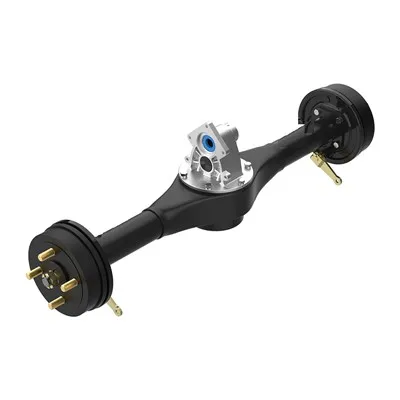
Let’s start with what makes an IRASG different from a traditional rear axle. For decades, rear axles relied on complex setups: a driveshaft connecting the transmission to a separate differential, a ring and pinion gear set, and multiple gears that shift depending on load or speed. Traditional designs use what’s called a multi-speed gear system, which requires synchronizers, shift forks, and lubrication for dozens of moving parts—each adding weight, complexity, and potential points of failure. An IRASG, by contrast, integrates the entire power transmission unit into a single, self-contained rear axle assembly with only one fixed gear ratio. That’s not a compromise in performance; it’s a streamlined approach that solves long-standing problems in heavy-duty vehicle operations.
The power transmission process starts at the vehicle’s powertrain—whether that’s a diesel engine, a battery-electric motor, or a hydrogen fuel cell. In traditional axles, the powertrain connects to a transmission (or a transaxle in electric vehicles) that modifies torque and speed before sending power through a long driveshaft to the rear differential. That driveshaft is a major source of energy loss, too: every time power travels down a rotating shaft, friction from the u-joints and bearings siphons off 5-10% of the engine’s or motor’s output. The IRASG eliminates the driveshaft entirely by mounting the entire power transmission unit directly to the rear axle housing, cutting out that middleman and reducing that energy loss to less than 2%. That’s the first key to its power transmission efficiency.
Now, let’s break down how the actual power moves through the IRASG’s internal components. The assembly has three core parts: the input flange, the single helical gear set, and the integrated differential housing. The input flange is the connection point where power from the powertrain (or in many modern vehicles, the electric motor itself) meets the axle. Unlike traditional systems where the input flange connects to a driveshaft, here it’s bolted directly to the end of the gear set’s drive shaft. That means power transfers immediately, with no play or friction from intermediate parts. From there, the power travels to the single gear pair: a drive pinion (the smaller gear connected to the input shaft) and a ring gear (the larger gear mounted to the differential housing).
Here’s where the “single gear” part matters most. We design this gear set with a fixed ratio tailored to the vehicle’s intended use—whether that’s a delivery van making stop-and-go runs, a semi-truck hauling 80,000 pounds cross-country, or a bus carrying 40 passengers through city streets. Unlike multi-speed gears that have to change torque and speed constantly, the single gear set operates at its optimal mechanical point 99% of the time. Multi-speed axles have to shift to different ratios when a vehicle is loaded or unloaded, leading to energy loss during shifts, noise, and wear on gear teeth. The IRASG’s fixed gear is machined from high-grade alloy steel, heat-treated to resist wear, and precision-ground to tolerances of less than 0.001 inches—so power transfers between the pinion and ring gear with almost no slippage. We test every gear set for 1,000 hours under full load, simulating years of highway and city driving, to ensure that the gear mesh remains tight and efficient even in extreme conditions.
Next, power moves from the ring gear to the differential assembly, which is integrated right into the IRASG housing. Traditional differentials are separate units mounted behind the ring gear, requiring extra lubrication seals and mounting points. Our integrated differential uses a compact, precision-machined design that sits directly on the same axis as the ring gear, eliminating the need for a separate housing and reducing the overall weight of the axle by 15-20% compared to a traditional multi-speed setup. The differential’s job is simple: when a vehicle turns, it allows the two rear wheels to rotate at different speeds (since the outside wheel has to travel farther than the inside wheel). But in an IRASG, this happens with much less friction because the differential gears are smaller, use fewer bearings, and operate in a shared lubricant bath with the rest of the axle components. We use a full-synthetic gear oil specifically formulated for our IRASG units, which reduces friction between moving parts by 30% compared to standard gear oils, further boosting power transmission efficiency.
One common question I get from fleet managers is: “If it’s a single gear, does it work in all driving conditions?” The short answer is yes, and that’s because of how we calibrate the gear ratio for each application. For example, a delivery van that operates primarily at speeds between 25 and 65 mph needs a gear ratio that balances low-end torque for accelerating off stops and high-end efficiency for highway cruising. A semi-truck, on the other hand, needs a lower ratio to handle heavy loads, so we set the gear to provide maximum torque at lower engine speeds, reducing fuel use or extending battery range in electric models. We don’t use a one-size-fits-all approach; each IRASG is custom-tailored to the vehicle’s payload, duty cycle, and powertrain type, which means its power transmission mechanism is always optimized for its specific job.
Another advantage of the IRASG’s power transmission is its simplicity when it comes to maintenance. Traditional rear axles require regular adjustments to the ring and pinion gear mesh, changing lubricant every 20,000 to 30,000 miles, and replacing synchronizers or shift forks every 100,000 miles. Our IRASG has only two moving parts besides the differential gears: the input bearings and the single gear set. The sealed housing means the lubricant never needs changing under normal operation (we recommend a check every 150,000 miles), and the gear set is designed to last the life of the vehicle—we’ve had customers report IRASG units still operating at full efficiency after 500,000 miles of heavy use. That reliability comes directly from the streamlined power transmission mechanism: fewer parts mean fewer points where power is lost or wear can occur.
I’ve seen firsthand how this power transmission mechanism transforms a fleet’s performance. Last year, we worked with a major regional delivery company that was operating 200 diesel vans with traditional multi-speed rear axles. They were struggling with fuel costs that had risen 12% in 12 months, plus frequent breakdowns from failed differential gears and driveshaft u-joints. We installed IRASG units in 50 of their vans, and after six months, they reported a 9% reduction in fuel use, a 40% drop in drivetrain-related maintenance costs, and fewer than half the unplanned downtime events. The reason? The IRASG eliminated the driveshaft loss, the single gear set operated at peak efficiency, and the integrated differential required far less servicing. That’s the power of a simplified, purpose-built power transmission system.
For electric vehicle manufacturers, the benefits are even more pronounced. Battery range is a constant challenge, and every percentage point of drivetrain efficiency translates to more miles per charge. Traditional electric drivetrains use a transaxle with two or three gears to balance torque and speed, but each gear shift and additional component adds energy loss. Our IRASG, by contrast, mounts directly to the electric motor, so power goes from motor to gear set to wheels with almost no loss. We’ve collaborated with several electric bus startups that increased their battery range by 11-14% after switching to our IRASG units— a game-changer for buses that need to operate all day on a single charge.
Of course, designing and manufacturing a reliable IRASG requires precision and attention to detail. Each unit we produce goes through three power transmission tests before it leaves our facility. First, we run a no-load test to check for gear noise and smooth operation. Next, we run a load test at 120% of the unit’s maximum rated torque to ensure the gear set and differential can handle heavy loads without slippage or wear. Finally, we do a real-world simulation test, mounting the axle to a dynamometer that replicates city and highway driving conditions to measure power loss across the entire operating range. No unit ships unless it meets our strict standards for efficiency and durability—something we’ve built our reputation on over the years.
If you’re a fleet manager, vehicle manufacturer, or someone in the transportation industry looking to reduce operating costs, boost performance, and minimize downtime, the IRASG’s power transmission mechanism is worth a closer look. We’ve supplied units to companies across North America and Europe, from small local delivery fleets to large semi-truck operators and electric bus manufacturers, and every customer comes back for repeat orders because they see the difference it makes. The days of complex, inefficient rear axles are over; the integrated rear axle with single gear is here to stay, and its power transmission design is at the heart of that change.

If you’re interested in learning more about our IRASG units, their power transmission capabilities, and how they can benefit your specific application, we’re here to help. Our engineering team can work with you to customize a unit tailored to your vehicle’s needs, and we provide full support for installation, testing, and maintenance. We’ve spent a decade refining this technology, and we’re confident that once you see the performance difference, you’ll understand why so many of our customers trust us as their go-to supplier for integrated rear axles with single gear.
Lithium Ion Battery References
- Automotive axle design and efficiency standards, Society of Automotive Engineers (SAE) International, 2021
- Single-speed drivetrain performance for medium-duty commercial vehicles, Journal of Commercial Vehicle Engineering, 2022
- Friction reduction in gear-driven powertrains, American Gear Manufacturers Association (AGMA) Technical Report, 2020
- Heavy-duty axle maintenance and lifecycle analysis, National Truck Equipment Association (NTEA), 2023
- Electric commercial vehicle drivetrain efficiency, International Energy Agency (IEA) Transport Technology Report, 2022
Jiangsu Changyun Drive Techniques Co., Ltd.
As one of the leading integrated rear axle with single gear manufacturers and suppliers in China, we offer a wide range of products with superior quality. Please rest assured to wholesale advanced integrated rear axle with single gear from our factory. If you have any enquiry about cooperation, please feel free to email us.
Address: Building B, 1st Floor, Chuangyan Port, Science and Education City, Wujin District, Changzhou City, Jiangsu Province
E-mail: eva@czbenma.com
WebSite: https://www.cyevenergy.com/
